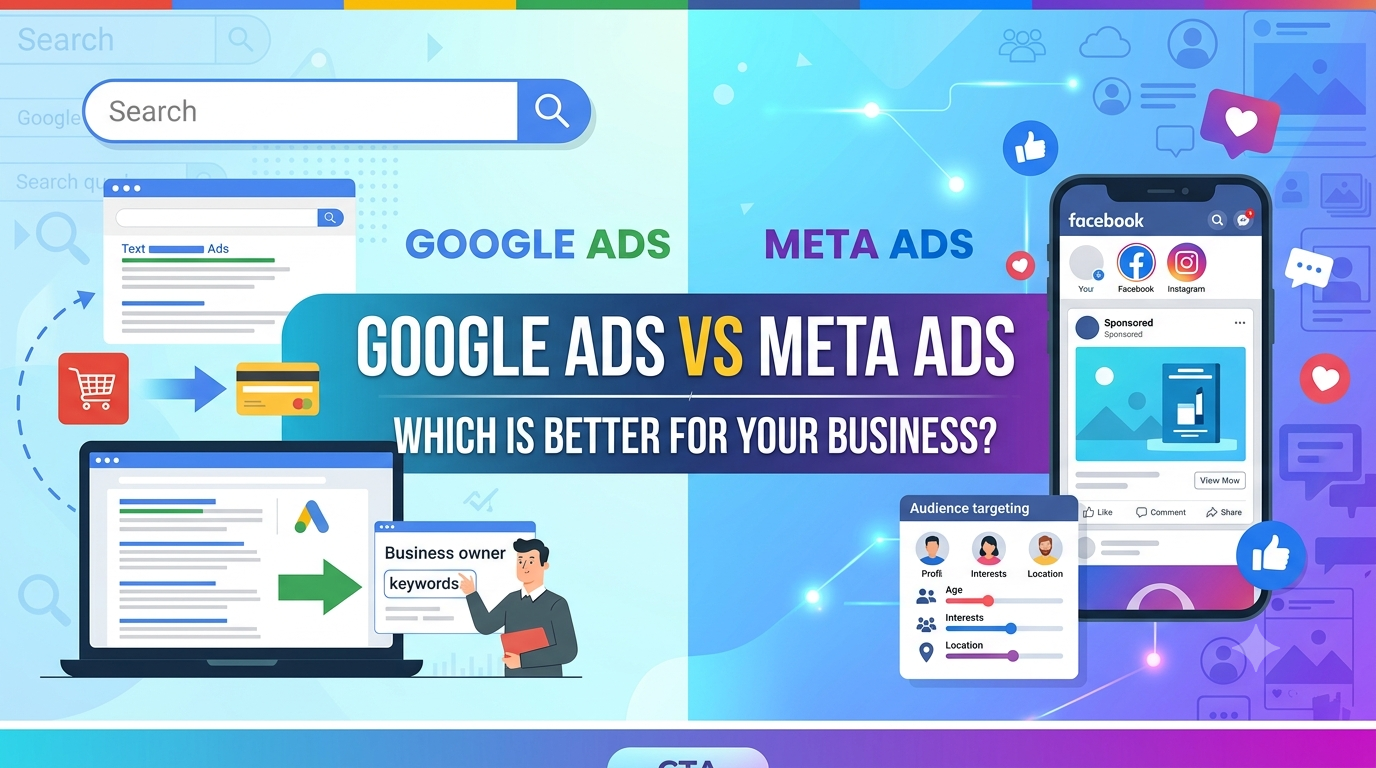
Google Ads vs Meta: Which Is Better for Your Business?
Google Ads vs Meta Digital advertising has become an important part of growing a business online. Businesses of all sizes use paid advertising to reach potential customers, generate leads, increase website traffic, and drive sales. Two of the most popular advertising platforms are Google Ads and Meta Ads.
But when it comes to Google Ads vs Meta, many business owners ask the same question: which advertising platform is better for their business?
The answer depends on your business goals, target audience, budget, product or service, and advertising strategy. In this guide, we will compare Google Ads and Meta Ads to help you understand how both platforms work and when you may want to use each one.
What Is This Advertising Platform? Google Ads vs Meta
Google Ads is Google’s online advertising platform. It allows businesses to display advertisements across Google’s ecosystem, including Google Search and other eligible placements.
Key Advantages for Businesses
- Reaches people with active search intent
- Useful for lead generation
- Suitable for local businesses
- Can target specific keywords
- Offers different campaign formats
- Provides measurable advertising data
What Are Meta Ads?
Meta Ads are advertisements that businesses can run across Meta’s platforms, including Facebook and Instagram.
Unlike search advertising, Meta Ads are generally designed to reach users based on audience characteristics and behavior rather than only what they are actively searching for.
For example, an online fashion store can use Facebook or Instagram advertising to show products to audiences based on relevant targeting signals.
Benefits of Meta Ads
- Strong audience targeting capabilities
- Useful for brand awareness
- Effective for visual content
- Suitable for Facebook and Instagram campaigns
- Useful for product promotion
- Can support lead generation and website traffic
Google Ads vs Meta Ads: Key Differences
Understanding the differences between the two platforms can help you choose an advertising strategy that matches your business goals.
1. Search Intent vs Audience Targeting
One of the biggest differences in Google Ads vs Meta Ads is how users are reached.
Google Ads can help businesses reach people who are actively searching for a product, service, or answer.
Meta Ads generally allow advertisers to reach selected audiences based on available targeting options and campaign objectives, even when those users are not actively searching for the advertised product.
This means Google Ads can be useful for capturing existing demand, while Meta Ads can be useful for creating awareness and reaching potential customers.
2. Customer Journey
Google Ads can work particularly well when a customer already knows what they need.
For example, someone searching for “SEO services for small business” may already be considering a service.
Meta Ads can be useful earlier in the customer journey. A person may discover a brand or product while browsing Facebook or Instagram and become interested after seeing an advertisement.
Therefore, both platforms can play different roles in the customer journey.
3. Advertising Formats
Google Ads and Meta Ads offer different advertising formats.
Google advertising can include search ads and other campaign types across Google’s advertising ecosystem.
Meta Ads are especially well known for visual formats across Facebook and Instagram, including image, video, carousel, and other supported formats.
If your business depends heavily on visual presentation, Meta can provide useful opportunities to showcase products and creative content.
4. Target Audience
Audience targeting is another important factor in the Google Ads vs Meta Ads comparison.
Google Ads can use search keywords and other available signals to help advertisers reach relevant audiences.
Meta Ads provide audience-focused advertising options that can help businesses reach specific groups based on available demographic, interest, behavioral, and platform signals.
Your ideal customer profile should therefore influence which platform you prioritize.
5. Budget Considerations
Your advertising budget is another important consideration.
Neither Google Ads nor Meta Ads has a universal price that applies to every business. Advertising costs can vary depending on factors such as competition, industry, audience, campaign settings, ad quality, location, and objectives.
Instead of choosing a platform based only on the lowest advertising cost, businesses should consider the quality of leads or customers generated and the overall return from their campaigns.
Start with a controlled budget, monitor performance, and optimize campaigns based on reliable data.
6. Best Platform for Different Business Goals
The right platform depends heavily on what you want to achieve.
Google Ads may be suitable for:
- Local service businesses
- Lead generation
- High-intent searches
- Professional services
- Businesses targeting specific search terms
- Products or services people actively search for
Meta Ads may be suitable for:
- Brand awareness
- Visual products
- eCommerce promotion
- Social media growth
- Audience discovery
- Product launches
- Content-driven campaigns
These are general use cases rather than strict rules. A business can potentially benefit from both platforms.
Google Ads vs Meta Ads: Which One Should You Choose?
There is no single answer to which platform is better for every business.
If your customers usually search on Google when they need your product or service, Google Ads may be an important part of your marketing strategy.
If your business depends on visual content, social discovery, brand awareness, or reaching specific audiences on social platforms, Meta Ads may be useful.
For some businesses, using both platforms can provide a more complete advertising strategy. Google Ads can help capture existing demand, while Meta Ads can help build awareness and reach potential customers earlier in their buying journey.
Tips for Running Successful Paid Ads
Regardless of which platform you choose, your campaign performance depends on more than simply creating an advertisement.
Keep these tips in mind:
- Define a clear advertising goal before starting.
- Understand your target audience.
- Create relevant and compelling ad copy.
- Use high-quality images or videos where appropriate.
- Create dedicated landing pages.
- Track conversions and important performance metrics.
- Test different ads and audiences.
- Review campaign data regularly.
- Avoid spending your entire budget before understanding performance.
- Optimize campaigns based on measurable results.
Final Thoughts
The Google Ads vs Meta Ads comparison is not really about finding one platform that is universally better. Both platforms have different strengths and can support different stages of the customer journey.
Google Ads can help businesses reach users with active search intent, while Meta Ads can help businesses build awareness and reach audiences across social platforms.
Before choosing a platform, consider your business goals, target audience, product or service, budget, customer journey, and available creative resources.
For many businesses, testing both platforms with clear goals and measurable conversion tracking can provide useful insights into which advertising approach works best for their specific situation.