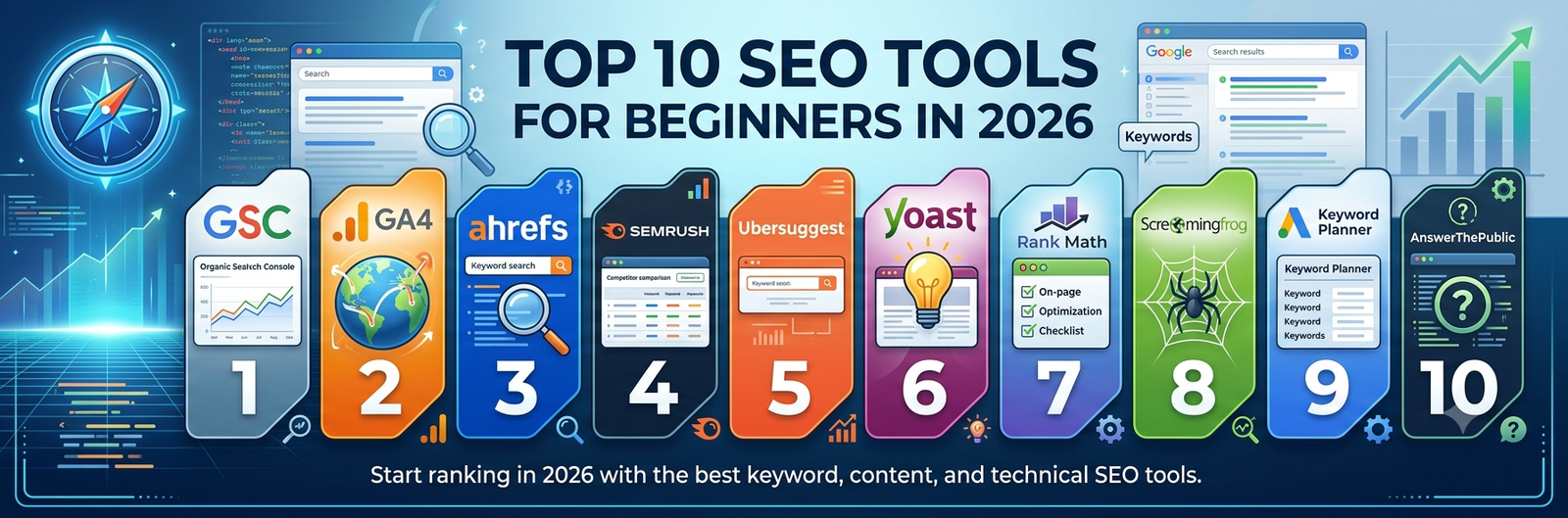
Top 10 SEO Tools for Beginners in 2026
Top 10 SEO Tools for Beginners in 2026 Search Engine Optimization (SEO) is one of the most important parts of growing a website online. Whether you have a business website, blog, eCommerce store, or digital marketing website, SEO can help you improve your visibility in search engine results.
However, SEO can be difficult for beginners because it involves keyword research, content optimization, technical SEO, backlinks, competitor analysis, and website performance. This is where SEO tools can make the process easier.
In this article, we will explore the Top 10 SEO Tools for Beginners in 2026 that can help you understand SEO, find keywords, analyze websites, and improve your search engine performance.
Why SEO Tools Are Important for Beginners
SEO tools provide useful data that can help you make better decisions about your website. Instead of guessing which keywords to target or what problems your website has, you can use SEO tools to analyze real data.
For beginners, SEO tools can help with:
- Keyword research
- Competitor analysis
- Website audits
- Backlink analysis
- Content optimization
- Keyword ranking tracking
- Technical SEO
- Finding content ideas
- Monitoring website performance
Using the right tools can save time and help beginners understand how SEO works.
1. Google Search Console
Google Search Console is one of the most useful free SEO tools for beginners. It is provided by Google and allows website owners to monitor how their website performs in Google Search.
You can use Google Search Console to check search queries, clicks, impressions, average search position, indexing status, and technical issues.
It can also help you identify pages that are not properly indexed and understand which keywords are bringing visitors to your website.
Best for: Search performance, indexing, and basic technical SEO.
2. Google Analytics
Google Analytics is another important tool for understanding website performance. It provides information about visitors, traffic sources, engagement, landing pages, and conversions.
For SEO beginners, Google Analytics can help answer important questions such as where website visitors are coming from and which pages receive the most traffic.
When used together with Google Search Console, it can provide a better understanding of organic search traffic and user behavior.
Best for: Website traffic and user behavior analysis.
3. Ahrefs
Ahrefs is a popular SEO platform that provides several tools for keyword research, backlink analysis, competitor research, content research, and website audits.
Beginners can use Ahrefs to discover keywords, analyze competing websites, and identify content opportunities.
Its backlink analysis features can also help users understand which websites are linking to their competitors.
Best for: Keyword research, competitor analysis, backlinks, and content research.
4. Semrush
Semrush is an all-in-one SEO and digital marketing platform. It offers tools for keyword research, competitor analysis, website auditing, backlink analysis, rank tracking, and content optimization.
For beginners, Semrush can be useful because many SEO activities can be performed from one platform.
You can use it to discover keyword opportunities, analyze competitors, and identify technical SEO issues affecting your website.
Best for: Complete SEO and digital marketing research.
5. Ubersuggest
Ubersuggest is a beginner-friendly SEO tool that can help users with keyword research, competitor analysis, content ideas, and backlink research.
If you are new to SEO, Ubersuggest can be easier to understand than some advanced SEO platforms. You can enter a keyword or website and get useful information about search volume, SEO difficulty, and content opportunities.
It is a useful starting point for bloggers, small businesses, and beginners learning SEO.
Best for: Beginner-friendly keyword and competitor research.
6. Yoast SEO
Yoast SEO is a popular WordPress SEO plugin. It helps website owners optimize their posts and pages for search engines without requiring advanced technical knowledge.
Yoast SEO can help with SEO titles, meta descriptions, readability, XML sitemaps, canonical URLs, and other important SEO settings.
For beginners using WordPress, it provides an easy way to manage many basic on-page SEO elements.
Best for: WordPress SEO and on-page optimization.
7. Rank Math
Rank Math is another popular SEO plugin for WordPress websites. It provides tools for optimizing pages and posts, managing metadata, creating sitemaps, and configuring various technical SEO settings.
One of its advantages is that many SEO options can be managed directly from the WordPress dashboard.
Beginners can use Rank Math to learn about on-page SEO while gradually becoming familiar with more advanced optimization features.
Best for: WordPress SEO and on-page optimization.
8. Screaming Frog SEO Spider
Screaming Frog SEO Spider is a website crawling tool designed to identify technical SEO problems.
It can help you find broken links, duplicate content, missing title tags, missing meta descriptions, redirects, and other technical issues.
Although it may look more technical than some beginner-focused tools, learning Screaming Frog can be valuable for anyone who wants to understand technical SEO.
Best for: Technical SEO audits and website crawling.
9. Google Keyword Planner
Google Keyword Planner is a keyword research tool from Google. Although it is primarily designed for Google Ads, it can also be useful for SEO keyword research.
Beginners can use it to discover keyword ideas and understand the potential search demand for different terms.
For example, if you are creating content about digital marketing, you can use Keyword Planner to discover related keywords and topics.
Best for: Keyword ideas and search demand research.
10. AnswerThePublic
AnswerThePublic is a useful tool for discovering questions and topics people search for online.
It can help content creators find long-tail keywords and question-based topics for blog posts, articles, FAQs, and other content.
For example, if your main topic is SEO, the tool can help you discover questions related to SEO that users may search for on Google.
This makes it particularly useful when you want to create content based on search intent.
Best for: Content ideas, long-tail keywords, and question-based searches.
How to Choose the Best SEO Tool for Beginners
You don’t need to use all ten SEO tools when you are just starting. The best tool depends on your SEO goals and the type of website you manage.
If you want free tools, start with Google Search Console, Google Analytics, and Google Keyword Planner. These tools can help you understand website performance and keyword research.
For advanced keyword research and competitor analysis, you can explore Ahrefs, Semrush, or Ubersuggest.
If your website is built with WordPress, Yoast SEO and Rank Math can help you manage on-page SEO.
The most important thing is to understand the purpose of each tool rather than simply collecting large amounts of SEO data.
SEO Tips for Beginners in 2026
Using SEO tools is helpful, but tools alone cannot guarantee better rankings. You also need a proper SEO strategy.
Here are some important tips for beginners:
- Focus on search intent when selecting keywords.
- Create useful and original content.
- Avoid keyword stuffing.
- Optimize your page titles and meta descriptions.
- Use relevant keywords naturally throughout your content.
- Improve website loading speed and user experience.
- Fix broken links and technical SEO problems.
- Monitor your organic traffic regularly.
- Analyze your competitors to find content opportunities.
- Update older content when necessary.
Final Thoughts
The Top 10 SEO Tools for Beginners in 2026 can help you learn and implement different areas of search engine optimization. From keyword research and content planning to technical audits and website performance, these tools can make SEO easier to understand and manage.
If you are completely new to SEO, start with free tools such as Google Search Console, Google Analytics, and Google Keyword Planner. Once you understand the basics, you can explore advanced platforms such as Ahrefs and Semrush.
Remember that SEO tools are only a part of a successful SEO strategy. Creating helpful content, understanding search intent, maintaining a technically healthy website, and consistently improving your content are also important for long-term SEO success.